

A Fully Furnished Utopia
For disillusioned Western conservatives, Russia offers an ideological home where embattled values can return to ordinary life.

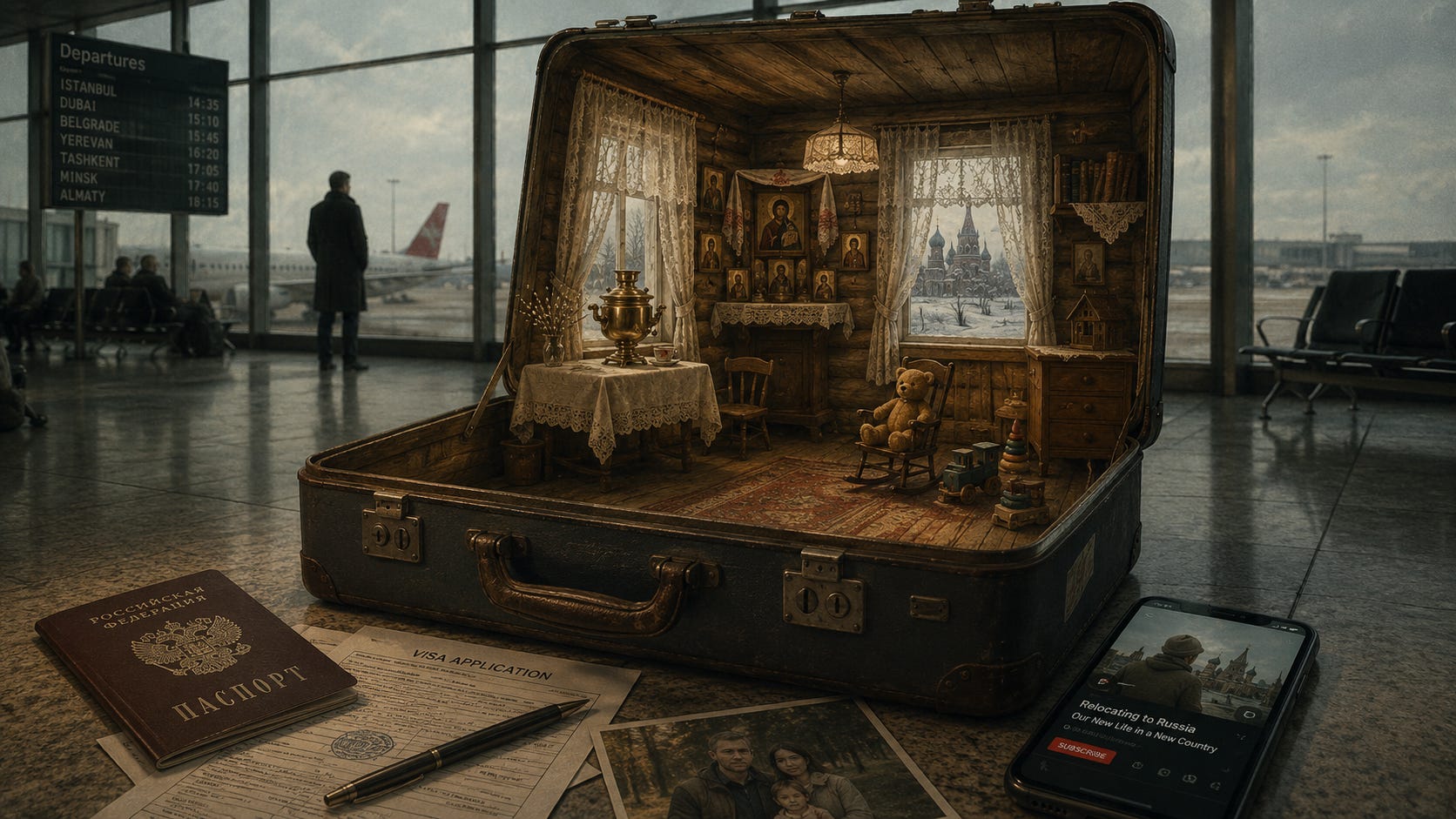
What do you do when you decide your country can no longer be fixed?
For a small number of Western conservatives, the answer is no longer to wait for the next election, it is to leave. Some withdraw into intentional communities or homesteads. Others go further, making the retreat literal by moving abroad in search of a society they believe already embodies their values. If you can’t outvote the world you live in, you can still outmove it.
Over the past decade, a few thousand Westerners have relocated to Russia, convinced it has preserved what their own countries have abandoned: traditional families, public Christianity, clear gender roles, and a state willing to defend them. In 2024, the Kremlin turned that aspiration into policy with a visa aimed explicitly at foreigners who reject the “neoliberal” trajectory of their own societies.
It is tempting to dismiss this as an odd footnote to the culture wars or to write these migrants off as useful idiots for Russian propaganda. But that misses the more compelling story. Their destination matters less than the political imagination behind it. This is a story about lived ideology: not merely holding a worldview, but seeking a place where it becomes the texture of everyday life.
It is tempting to dismiss this as an odd footnote to the culture wars or to write these migrants off as useful idiots for Russian propaganda. But that misses the more compelling story. Their destination matters less than the political imagination behind it. This is a story about lived ideology: not merely holding a worldview, but seeking a place where it becomes the texture of everyday life.
Russia as Aspirational Illiberalism
Utopia, in its original sense, means no place: a future so ideal that it remains, by definition, unreachable. In practice, though, the no-place has just as often had an address. The Wild West functioned as one for generations of American settlers; America itself was one for the millions of migrants who crossed an ocean toward it; and for most of the twentieth century, the West was a concrete utopia for dissidents on the far side of the Iron Curtain.
What’s happening now looks like that same logic running in reverse, on a far smaller scale. The reasons people give for moving to Russia (and, in recent years, to Orbán’s Hungary) are remarkably consistent, and worth taking seriously rather than dismissing.
The point here is not to judge the conservative or liberal nature of “real” Russia. It is to understand the Russia being imagined and moved into.
For many, it starts with family values: alarm at what they see as the erosion of traditional gender roles and parenting norms, sex education curricula, gender identity discussions in schools, a sense that state and culture alike were pulling their children in directions they hadn’t chosen. Russia’s codified “traditional values” stance, enshrined to the point of state decree, reads to them as proof of a state strong enough to commit to its values.
For others, it’s a broader exhaustion with liberal democracy itself: a feeling that Western political systems no longer represent ordinary people and that dissent is punished rather than protected. The framing is counterintuitive but consistent: a paternalistic system with authority and strong leadership, they argue, offers more genuine freedom to live as one chooses, so long as those choices remain within the moral order the state protects.
The COVID-19 pandemic looms large as a hinge point, with lockdowns and mandates convincing a number of future émigrés, particularly those connected to Germany’s Querdenker milieu or to QAnon-adjacent networks, that their own governments had crossed a line.
Underneath both runs a more anxious thread: anxiety about migration bound up with a cultural Christianism, that is an attachment to Christianity less as personal devotion than as civilizational identity. Russia’s appeal here lies in having kept that identity as a live reference point, against a Western Christianity many see as having grown too accommodating to mean much anymore.
Together, these motives add up to what we might call aspirational illiberalism: not a defection toward a specific doctrine, but a yearning for an order that promises clarity, hierarchy, and protection in exchange for compliance. Russia doesn’t need to be loved on its own terms to satisfy that yearning. It only needs to be illiberal in the right direction, at the right moment… with a visa application attached.
what we might call aspirational illiberalism: not a defection toward a specific doctrine, but a yearning for an order that promises clarity, hierarchy, and protection in exchange for compliance. Russia doesn’t need to be loved on its own terms to satisfy that yearning.
Turning a Feeling into a Pathway
Feelings don’t get you a residence permit, but bureaucracy does. In August 2024, the Russian government launched the “Shared Values” visa, quickly nicknamed the “anti-woke visa” in Western media. It asks for none of the usual things: no language test, no investment, no family ties, only ideological alignment, mainly opposition to multiculturalism and LGBTQ+ rights. By mid-2026, around 3,500 people had applied, and roughly 1,200 had moved, the largest single group from Germany, followed by France and the United States.
Around the visa, a whole ecosystem has emerged, much of it organized by Maria Butina, the former American gun-rights activist convicted as a foreign agent in the US and now a member of the Russian parliament: an NGO overseeing the visa program, a cultural outreach platform offering relocation guidance and Orthodox matchmaking, and a media network aggregating expatriate content creators.
Two physical projects make the dream concrete. Dobrograd, a planned community near the historic town of Vladimir, markets itself to conservative émigrés as a haven for traditional, Christian living, symbolically important even though still sparsely populated. The “American Village,” the brainchild of long-time Russia-based blogger Tim Kirby, aims to build a gated rural settlement for disillusioned American conservatives; Kirby partnered with Fr. Joseph Gleason, an American Orthodox priest who relocated and converted years earlier and is now known in Russia as Father Iosif, perhaps the clearest case in this story of inner disposition becoming outer biography.
Despite Kirby’s claim that 200 families had expressed interest, only a handful of households had actually moved in by mid-2026. Indeed, the dream and the logistics rarely match. Closing that gap takes work: the real, physical reshaping that bodies, households, and expectations must undergo to fit the fiction.
The “shared values” visa grants temporary residency only. To stay in Russia, people need to find a way to get permanent residency within the three years the visa allows. Jobs for foreigners are largely limited to English teaching or media work; rural housing of the kind marketed by projects like the American Village often lacks basic infrastructure and demands real money to make livable. Some émigrés, after running into these walls, quietly return home or disappear from public view, an ending far less photogenic than the one their own vlogs promised.
The ones who make it work, though, get the opposite treatment: Russian state media plays up their relocations as Western exiles fleeing persecution. Some were already pro-Russian figures at home, others became minor celebrities once in Russia.
A Texan father who moved his family over what he called sexual content in his children’s schooling went on to volunteer for military service in Ukraine and publicly thank Putin for his new citizenship. The Griesbach family, tied to Germany’s Reichsbürger movement, moved with their eight children, left when the bureaucracy proved too much, then resettled a second time, this time to an official welcome from regional authorities. An Austrian former foreign minister relocated after years of pro-Russian controversy and founded a Eurasianist research center, framing her move as intellectual freedom. What unites these otherwise disparate cases is less ideology than narrative utility: each becomes, in Russian state media’s hands, proof that the West persecutes its own.
The Cottage Industry, Russian Version
What started as scattered, individual choices has hardened into something closer to an industry. A growing ecosystem of Western expatriates now produces dozens of podcasts and video content across YouTube, Spotify, Telegram, Rumble, and RuTube, reaching hundreds of thousands of followers, and in a few cases millions.
For many newcomers, especially those without Russian-language skills or easy access to the local labor market, becoming an influencer is not only a way to narrate the move but also one of the few plausible sources of income. The Huffman family, Texans who relocated to the Moscow region and turned their settlement in the American Village into a YouTube project, offers an especially clear example of this monetization model.
Alexandra Jost, who runs “Sasha Meets Russia,” has built her following on bilingual Moscow tours and expat interviews; Lorenzo Bagnati, or “Super Italiano,” is the genre’s biggest commercial success, with over two million YouTube subscribers built on a playful, apolitical diet of food and travel content.
The dominant pitch is moral order and everyday normalcy: Russia offers clean cities, low crime, and room to raise kids without “woke” pressure in schools. A second cluster sells economic arbitrage: cheap housing and domestic help, with Moscow and St. Petersburg pitched as world-class but affordable and provincial cities as even better value. A third sells faith as backdrop rather than battleground: Orthodoxy presented not as doctrine but as ambient fact, full churches, observed fasting seasons, a public language of tradition that still seems to mean something. And running under all three is the suggestion of a country not really at war: life is stable, shelves are full, sanctions are an inconvenience at worst.
Many of these channels also function as soft funnels into relocation consultancies, bundling visa advice, real estate, matchmaking agencies, and school enrollment into the same feed that’s selling the lifestyle, and several link, directly or through guests, to state-adjacent outreach programs and regional investment campaigns. Influencers are no longer just describing the move, but selling it too.
If You Can’t Outvote It, Outmove It
Utopian thinking has traditionally meant imagining a better society that does not yet exist. The people in this story reverse the sequence: instead of designing an ideal future, they search the map for a country that appears to embody it already.
Russia, in that sense, matters less than what it represents. It becomes a vessel for aspirations that many of its admirers feel can no longer be realized at home: moral certainty, cultural continuity, public religion, and political order. Obviously, reality can be disappointing, and some newcomers quietly leave. But those disappointments rarely invalidate the original impulse, because the migration was never simply about Russia. It was about finding a place where one’s worldview no longer felt embattled, but ordinary. And indeed, in Russia, this ordinariness is produced not only by state ideology, but also by a softer conservatism embedded in everyday life, where it appears as “common sense.”
Ideological emigration to Russia belongs to a broader transformation in the political imagination. Across the contemporary West, dissatisfaction increasingly generates projects of exit rather than projects of repair. Some dream in a Silicon Valley register of network states, charter cities, seasteads, sovereign tech enclaves, or, at the far edge of the imagination, new communities on Mars. Others retreat into intentional communities. A few cross borders altogether. The common intuition is the same: when politics no longer seems capable of remaking society, changing societies begins to look easier than changing politics.
The utopia is not that Russia is perfect, but that ideology no longer has to be an aspiration; it can become everyday reality.
Ideological emigration to Russia belongs to a broader transformation in the political imagination. Across the contemporary West, dissatisfaction increasingly generates projects of exit rather than projects of repair. […] The common intuition is the same: when politics no longer seems capable of remaking society, changing societies begins to look easier than changing politics.
A good example of how “Russia, in that sense, matters less than what it represents” is precisely the whole COVID-sceptic scene, hailing Russia as some kind of paradise while most of the country had been in lockdown and restricted access to events and restaurants to vaccinated people via QR code just like the Western countries they so despise for it. But as you point out, although it’s mind-bogglingly illogical, none of that matters: what matters is the utopian (I will even say delusional) view of Russia as some kind of conservative paradise. The BBC recently had an article about disillusioned émigrés: https://www.bbc.com/news/articles/cn075j04pnyo . Of course, I can’t judge how representative these cases are, but they do show a certain “you don’t know what you’ve got ‘till it’s gone” dynamic at play as well.
This is a very insightful way of taking these migrants seriously, not as naïve victims of propaganda, but as people making coherent choices about the kind of moral and political order they want to inhabit.
It also raises a question for me: would they make the same choice if they had to enter Russia on the same terms as ordinary Russians, with no easy exit, or only at very high personal cost?
This seems connected to your essay on Thiel. If people genuinely possess freedom of choice and exit, countries may begin to look like products in a marketplace: one could shop for the political, cultural, and moral environment one prefers. But sovereignty complicates that analogy. A consumer can stop buying a product. Can a citizen really stop belonging to a state?
Perhaps this is precisely a goal worth pursuing for liberals. A world in which states could genuinely be “shopped for” might be closer to a liberal utopia: anyone could choose where to live according to their political ideals and ideological preferences, and could leave again at any time. There would no longer be “illegal immigrants,” prohibitions on working, detention, or deportation. The decisive freedom would not simply be the freedom to choose a country, but the freedom to exit it after the choice has been made.