

Vivatopia
Lived Ideologies and Political Futures

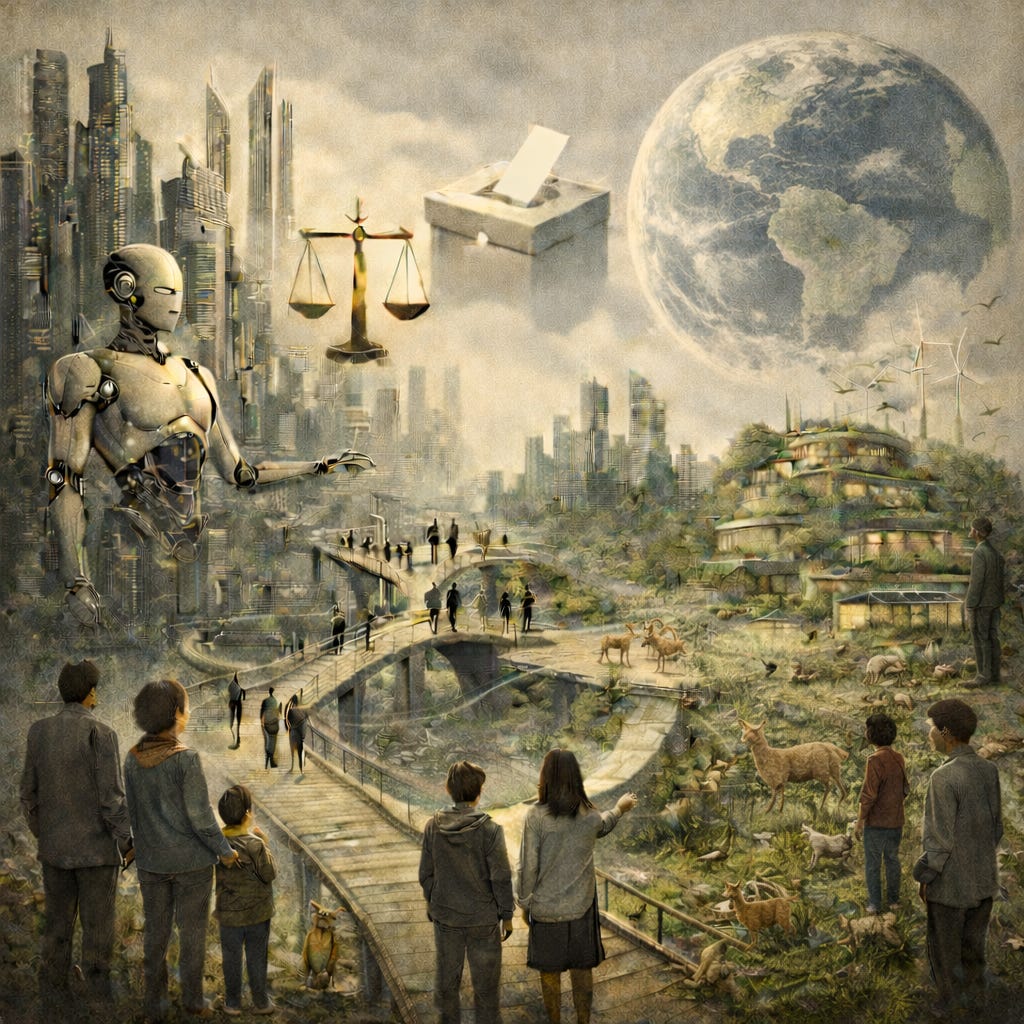
Politics is never only about institutions, interests, or power relations. It is also about ways of life, everyday practices, cultural codes, moral intuitions, social attachments, consumption—in other words, about lived ideologies. Political identity is expressed through branded clothing, flags, social media aesthetics, parallel media ecosystems, and boycotts or loyalty to specific companies. It is something one inhabits and enacts.
Looking at politics through lived ideologies makes it possible to see why political divides are so resilient and emotionally charged. When politics is woven into everyday life—into family norms, leisure, religion, humor, taste, and consumption—it requires attention to the cultural and symbolic infrastructures that sustain political identities and make certain social orders feel morally self-evident.
But politics is also about imaginaries: the shared ways through which societies make sense of authority and legitimacy, imagine social order and disorder, define progress and decline, and project themselves into the future. Politics today is not only strained by institutional fatigue, polarization, or democratic backsliding. It is also facing something more elusive, but no less consequential: a crisis of imagination.
We are trapped in a narrow repertoire of categories and expectations—visible in a political language that increasingly circles around prefixes (post-, neo-, de-) naming exhaustion rather than direction. At the same time, imagination is not a luxury; it is political precisely because it connects critique of the present to plausible horizons of transformation.
Much of my recent work at the Illiberalism Studies Program has been devoted to understanding how dominant liberal narratives are being challenged and recomposed. Illiberalism and postliberalism, in their many forms—sovereigntism, civilizationalism, nationalism…—are attempts, whatever we think of them, to rebuild meaning in a world where liberal promises of progress and universality no longer feel self-evident.
For me, studying illiberalism has also meant studying imagination: how political actors reinterpret the past, redraw moral boundaries for the present, challenge liberal hegemony, and propose alternative futures.
In my work on Russia, I have looked at how conservative, civilizational, and imperial ideas circulate between state discourse, intellectual milieus, religious institutions, and everyday cultural practices, producing forms of political common sense that are lived long before they are formalized as doctrine.
I chose the name Vivatopia to evoke not an abstract, far-off utopia, but the vitality of political futures that remain open to construction and contestation. It is also about refusing a false binary between a supposedly exhausted present and an empty future.
Multiple imaginaries coexist in parallel: liberal and illiberal, technocratic and ecological, humanist and post-human, national and planetary, nostalgic and accelerationist. They blur traditional left–right divides and escape inherited ideological maps. To understand politics today requires taking this plurality seriously, without forcing it prematurely into stable categories or making a definitive choice.
This channel is a space to explore these questions. It looks closely at current political changes—democratic fatigue, sociocultural changes, geopolitical reordering, technological acceleration—with a more forward-looking inquiry into how political futures are being reopened.
Some posts will engage theory and intellectual history; others will read current debates, policy languages, or cultural productions as symptoms of deeper shifts in political imagination. I will move between the everyday and the structural, the national and the global, the micro and the macro. The aim is to make visible the symbolic architectures that organize political life today, and to ask how they might change.
If democracy is to be renewed rather than merely managed, it requires moving beyond institutional tinkering and rethinking the imaginaries through which we project our collective life. We need to reclaim political imagination itself.
Very interesting. Will you give definitions to the terms you use? That would be very helpful for understanding the competing ideologies confronting those who believe in freedom. Perhaps a definition of liberalism? What is a liberal etc.? Take care.