

Which Strategic Autonomy for a Far-Right Europe?
The Case of the French National Rally

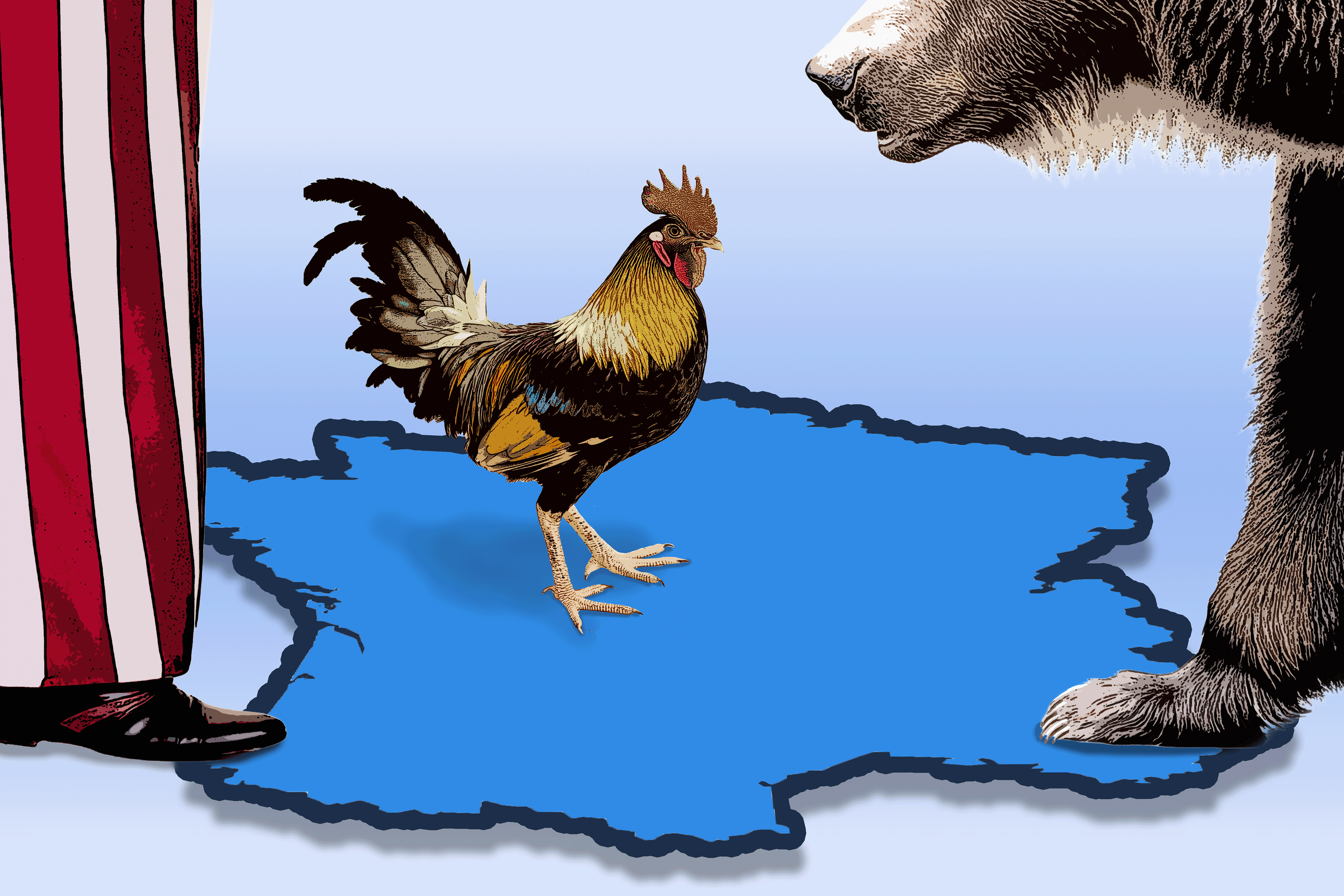
A few weeks ago, The Conversation commissioned me to write a piece about the French National Rally’s (RN) potential strategies toward the United States and Russia, should the party of Marine Le Pen and Jordan Bardella win the presidency in 2027. All the assumptions and fears of mainstream political thinking were implicit in this request. The idea, basically, was that France would align itself with Trump and Putin against the European Union should the RN win.
This framing rests on a Manichean view of the world: defend the EU against the American and Russian empires, or side with them against Brussels. Well, the world is not that simple.
Rather than a simple alignment, what may be at stake is the emergence of an illiberal European political consciousness, a “Europe of nations” that is ideologically convergent with Trumpism and Putinism yet unwilling to subordinate itself to either. Many fear such a development. Yet as far-right parties already lead—and may soon lead more—governments across Europe, the real question is whether they will act as external proxies or articulate a continental nationalism capable of asserting strategic autonomy.
As far-right parties already lead—and may soon lead more—governments across Europe, the real question is whether they will act as external proxies or articulate a continental nationalism capable of asserting strategic autonomy.
Let’s unpack the arguments.
First: yes, Putin’s Russia, Donald Trump’s United States and far-right parties in Europe share a set of common values that I define as illiberal. I use this term descriptively, not normatively.
The illiberal political offer revolves around five core elements: the defense of national sovereignty against supranational and multilateral institutions associated with the liberal international order; support for a multipolar world over liberal universalism; a preference for strong executive power over what they see as overreaching courts and minority rights; a homogenizing vision of the nation rather than a multicultural one; and the defense of conservative values and traditional social hierarchies against what they interpret as progressive relativism.
Second: yes, this shared ideological framework enables the adoption of a number of common political strategies, particularly the denunciation of the European Union, seen as an instrument in the hands of unelected technocratic elites seeking to dissolve national identities into a cosmopolitan and progressive globalism.
This shared goal also entails mutual support and solidarity. For years, Russia has been supportive of illiberal regimes in Europe, like Viktor Orbán’s Hungary. It has also been supportive of illiberal parties. Some of these were in governing coalitions, like the Lega in Italy or the FPÖ in Austria a few years ago, while others are not but remain powerful electorally, like the French RN and the German AfD. Finally, Russia has also supported small ultra-right groups; for instance, by receiving them at the “Paladins” Forum in St Petersburg in September 2025. On the other side, the United States National Security Strategy, published in December 2025, acknowledges that “America encourages its political allies in Europe to promote this renewal of spirit, and the growing influence of European patriot parties indeed gives cause for great optimism.”
One could debate where the boundary lies between solidarity among ideological allies and interference in the domestic affairs of another country. That is not my focus here. I would simply note that movements aligned with political liberalism have also built transnational networks of solidarity, provided financial and symbolic support, and at times engaged in forms of political intervention on behalf of their allies.
So, does that settle the question? Not at all. This is precisely what mainstream analyses often overlook: sharing the same illiberal “software” does not automatically translate into strategic alignment. The picture is more complex, and it deserves closer examination.
Consider U.S.–Russia relations since Trump’s reelection. They have hardly resembled the honeymoon many Europeans feared. There are several reasons for this. The Trump administration itself is a coalition of actors with differing foreign policy cultures and divergent views of Russia. More importantly, although dialogue with Moscow has resumed, the central issue—a settlement of the war in Ukraine—remains unresolved, and structural tensions persist.
Trump’s rhetoric on Greenland, for instance, clearly identifies Russia as a strategic competitor in the Arctic, even if Moscow’s posture there may be more defensive than offensive, as Lukas Wadhen has argued in his Substack on Arctic affairs. Washington has directly attacked key Russian partners such as Venezuela and Iran, showing little concern about potential Russian retaliation, and has sought to undermine Moscow’s energy revenues. This occurs even as both countries cautiously explore limited economic cooperation in an attempt to manage the strategic impasse over Ukraine.
The pattern extends further. Washington has expressed frustration with Beijing’s and New Delhi’s continued engagement with Russia and has attempted to weaken that alignment. It has also criticized BRICS narratives of de-westernization and de-dollarization. Even as it prioritizes China as its principal long-term strategic rival, the Trump administration still treats Russia as a problem to be contained and weakened—both to limit Moscow’s ability to disrupt U.S. primacy and to prevent a tighter Russia–China alignment—so that Washington can concentrate its resources and attention on the competition with Beijing.
On the Russian side, the picture is even more ambiguous. Moscow appears to be playing a careful game with Washington wherein it is ready to resume dialogue and even to contemplate a possible illiberal partnership, yet is under no illusion about its durability. Trump is celebrated in Russian discourse as a disruptive figure who weakens the Western liberal order, but the United States is still regarded as Russia’s principal strategic competitor. I will return in a future post to the Russian elite’s evolving view of Trumpism.
This brings us to the European illiberals, and especially to the French RN.
After Russia’s invasion of Ukraine in 2022, the RN was compelled to gradually distance itself from Russia and recalibrate its discourse. This distancing was undertaken in order to remain aligned with a French public opinion that had become largely critical of Moscow. References to Ukraine as part of the Russian world fade away, giving rise to a more nuanced discourse, focused mostly on the economic cost of the war and the risk of a global military confrontation with Russia.
This repositioning does not erase the party’s past relations with Russia or the networks that still connect some of its figures to Russian actors. The political and financial interfaces carried primarily by Aymeric Chauprade and Jean-Luc Schaffhauser (both of whom have since left the party) have been well-documented. Thierry Mariani’s openly pro-Russian stance contributed to normalizing favorable readings of Moscow within the party. MEP Philippe Olivier, Marine Le Pen’s brother-in-law, as well as numerous other party candidates, have had or still have direct ties to Russia. More recently, Patrice Hubert, appointed RN Director General in 2025, has also illustrated this pattern: his prior professional experience in Russia and his past role as the, then FN’s, correspondent in Moscow signal a more discreet, managerial integration of familiarity with Russia within the party apparatus, rather than explicit activism.
What about links with the United States? The RN has historically displayed a stronger Russian than American inclination, due both to the movement’s history and to the ideological orientations of the Le Pen family. While other European far-right parties were more enthusiastic about Donald Trump’s re-election—such as Germany’s AfD or Austria’s FPÖ—and while Giorgia Meloni positioned herself as the national-conservative leader closest to the Trumpist world, the RN has remained more ambivalent.
While other European far-right parties were more enthusiastic about Donald Trump’s re-election—such as Germany’s AfD or Austria’s FPÖ—and while Giorgia Meloni positioned herself as the national-conservative leader closest to the Trumpist world, the RN has remained more ambivalent.
These ambiguities are not new: during Trump’s first term, the RN distanced itself from figures such as Steve Bannon when he sought to create a European far-right international, and only Marion Maréchal’s networks drew closer to him. The circles of Reconquête around Éric Zemmour, particularly Sarah Knafo, have been far more explicit in their admiration for Trump and the MAGA movement than the RN.
The RN prefers to remain in an ideological “in-between.” Jordan Bardella did not hide his admiration for Trump upon his re-election and had planned to attend the Conservative Political Action Conference (CPAC) in February 2025, before canceling at the last minute following controversy over Steve Bannon’s Nazi salute. He paid tribute to Charlie Kirk after his killing. Bilateral contacts have also continued around Marine Le Pen’s trial, with the American administration (like the Russian one) clearly interpreting the ruling as a political act and openly expressing support for the candidate.
The new U.S. Under Secretary of State for Economic Affairs, Jacob Helberg—professionally and personally connected to major Trump-aligned figures in Silicon Valley, such as Peter Thiel and his company Palantir—has served as a liaison between Washington and the French right more broadly, from Reconquête to the RN and the Republicans (LR).
In spite of these contacts, public distancing from the Trump administration has become more pronounced since January. The RN clearly opposed the abduction of Nicolás Maduro in Venezuela, denouncing it as a blatant violation of national sovereignty and international law. Marine Le Pen declared that “national sovereignty is never negotiable,” while Thierry Mariani stated that “Trump treats us like a colony.” The same applies to American demands to purchase Greenland from Denmark: Bardella vigorously denounced the “return of imperial ambitions” and economic blackmail.
What to conclude?
One may of course interpret the RN’s unease toward Donald Trump as simply a discursive adjustment aimed at remaining aligned with public opinion, in a largely electoral logic: the RN’s candidates will need the votes of the traditional right, and even of disillusioned Macron voters, to attempt to win the second round of the presidential election. Trump’s policies function as a repellent for roughly half of the French population, who view him as an enemy of Europe.
But there is another explanation, one that mainstream thinking is often reluctant to acknowledge.
Like other European far-right movements, the RN has embraced the idea of a Europe of nations that should assert itself on the international stage while largely dismantling the supranational project of the EU. The RN’s position is not as “EU-compatible” as Giorgia Meloni’s, but it no longer advocates “Frexit” either; rather, it resembles Viktor Orbán’s stance.
This illiberal Europe of nations corresponds in part to the ambitions of both Russia and Trump’s United States, but it is not subordinate to them: Meloni may be, for instance, at odds with Washington over aid to Ukraine, tariffs, and American expansionism, just as Orbán clashes with Trump over his privileged relationship with China.
The difficulty lies in the fact that, seen from Europe, the Trumpist project is more imperial than national, asserting that great powers have the right to seize new territories at the expense of existing nation-states, as illustrated by expansionist rhetoric toward Greenland. It may therefore come into contradiction with the nationalist ambitions of European forces that are otherwise and nevertheless ideologically close to it.
The same could be said of Russia’s imperial project, which alienated potential allies in countries such as Poland precisely because of its imperial dimension. Ideologically, the Law and Justice (PiS) party, which governed between 2015 and 2023 and is well-positioned to return to power in 2027, had an affinity for the values gestured at in Russian discourse about a true, Christian, conservative Europe that could have help a dialogue between both countries.
What does that tell us?
First, that the illiberal alliance and the shared agenda of profound transformation of the EU are limited by domestic political constraints. Should Marine Le Pen or Jordan Bardella come to power, their priority would likely be to secure re-election and maintain an image of governability in a context where they would remain politically removable (through parliamentary censure or electoral alternation) and legally constrained (by the Constitutional Council and administrative courts).
Second, that the uncertainty related to their geopolitical positioning does not come from ideological confusion, but from a tension at the heart of the illiberal project for Europe. The claim of a continental European nationalism could, in theory, make a “Europe of nations” an autonomous strategic pole, neither subordinate to Washington nor aligned with Moscow.
The claim of a continental European nationalism could, in theory, make a “Europe of nations” an autonomous strategic pole, neither subordinate to Washington nor aligned with Moscow.
In practice, however, the RN would be forced to arbitrate between two already tested trajectories: a “Meloni-style” path, seeking to adjust certain European policies from within (on immigration, environment, LGBTQ+ rights, etc.) without challenging the supranational architecture, and an “Orbán-style” path, more openly confrontational toward EU institutions.
In either case, the transformation of the European political framework would proceed through a gradual shift toward illiberal reference points convergent with those of Trump’s United States and Putin’s Russia, without erasing the geopolitical and economic rivalries that structure the international order.
Because ideological convergence does not erase structural competition. Political futures emerge from the friction between shared imaginaries and competing projects of power. Illiberalism is not the new “end of history,” but a new terrain on which familiar struggles over sovereignty will continue to unfold.